
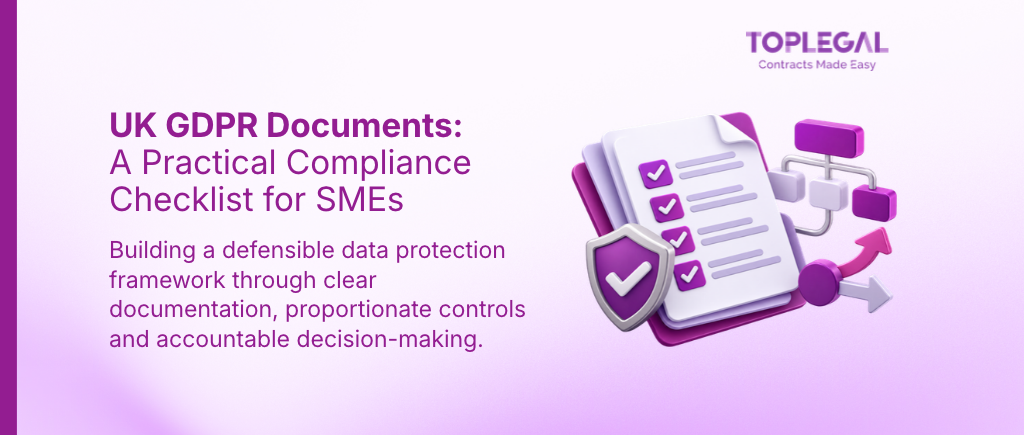
Building a defensible data protection framework through clear documentation, proportionate controls and accountable decision-making.
For UK SMEs, data protection compliance is not achieved by publishing a privacy policy alone. Businesses must understand what personal data they collect, why they use it, who receives it and how long it should be retained. Appropriate documentation provides evidence of those decisions and helps translate legal obligations into operational practice.
The commercial risk is material. The Government’s Cyber Security Breaches Survey 2025/2026 found that 43% of UK businesses had identified a cyber security breach or attack in the preceding 12 months. Source: UK Government Cyber Security Breaches Survey 2025/2026
A breach does not automatically establish a GDPR infringement, but it highlights why documented security and incident-response procedures matter.
The Essential UK GDPR Document Checklist
SMEs should assess whether they need the following documents, based on their activities and legal obligations:
- Privacy notice: Explain what personal data is collected, purposes, lawful bases, retention, recipients and individuals’ rights.
- Record of processing activities: Document relevant processing operations. Article 30 provides a limited exemption for some organisations with fewer than 250 employees, but exceptions apply, including certain ongoing, risky or sensitive processing.
- Data-processing agreements: Put appropriate written terms in place when processors handle personal data on the business’s behalf.
- Data protection policy and retention schedule: Establish responsibilities, secure handling, retention periods and deletion procedures.
- Data breach response procedure: Set out reporting routes, investigation responsibilities, containment and notification decisions.
- Data protection complaints procedure: Since 19 June 2026, controllers must have a process for handling data protection complaints, including acknowledging each complaint within 30 days and keeping the complainant informed of progress.
- Data Protection Impact Assessment (DPIA): Complete one before processing likely to result in high risk to individuals.
- Cookie and direct-marketing documentation: Review cookie consent arrangements, marketing permissions and opt-out processes where applicable.
- International transfer safeguards: Assess the legal mechanism required when personal data is transferred outside the UK.
What to Consider
Under UK GDPR, a reportable personal data breach must generally be notified to the Information Commissioner’s Office (ICO) without undue delay and, where feasible, within 72 hours of becoming aware of it, unless it is unlikely to pose a risk to individuals’ rights and freedoms. Individuals must also be informed in certain high-risk circumstances.
The ICO can impose a maximum penalty of £17.5 million or 4% of worldwide annual turnover, whichever is higher, for certain serious infringements. This is a statutory maximum, not an automatic fine.
Practical Takeaway
Maintain a central document register, assign owners, review documents when processing changes and test whether procedures work in practice. Documentation should reflect actual operations – not simply provide a paper trail.
References:
ICO: Maximum fines under UK GDPR
ICO: How to deal with data protection complaints
This article provides general information, not legal advice. Requirements depend on the nature and scale of processing.
Streamline Legal Document Management with TopLegal.ai
TopLegal.ai is an online platform designed for individuals, SMEs, landlords, freelancers and families seeking cost-effective legal document solutions. It offers pay-per-document pricing and subscription plans for unlimited access to document creation services, with encryption and security protocols designed to protect user data and document confidentiality.
Its curated document packages are intended to help businesses organise essential legal, financial and corporate documentation. Smart technology can simplify document-related tasks, save time and help business owners focus on growth. Documents should still be tailored to the organisation’s actual processing activities and reviewed where specialist advice is necessary.
Explore our packages: https://toplegal.ai/document/package
Start a Business with us : https://toplegal.ai/start-business
Explore readymade legal documents : https://toplegal.ai/documents
Contact us : https://toplegal.ai/contact