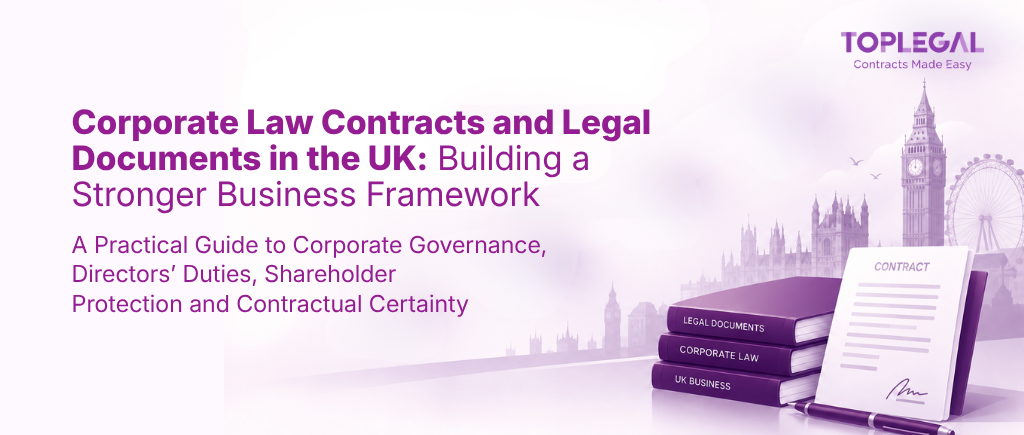
A Practical Guide to Corporate Governance, Directors’ Duties, Shareholder Protection and Contractual Certainty
What Corporate Documents Should a UK Business Have?
A well-governed company keeps documentation that accurately reflects who owns it and how decisions are made. The key documents usually include Articles of Association, a Shareholders’ Agreement, a Founders’ Agreement, Share Subscription Agreements, Share Transfer Agreements and Board Resolutions.
Companies must also maintain statutory and accounting records. Directors are personally responsible for ensuring that annual accounts and confirmation statements reach Companies House on time, together with notifications of changes to directors, the registered office, share allotments and people with significant control.
Corporate Law Documents: A Practical Business Checklist
Before establishing or expanding a UK company, directors and founders should consider the following:
* Appropriate company structure and Articles of Association
* Shareholders’ or Founders’ Agreement
* Clear ownership and share allocation records
* Directors’ responsibilities and decision-making procedures
* Board and shareholder resolutions
* People with Significant Control information
* Identity verification for directors, PSCs and anyone filing on the company’s behalf
* Intellectual property ownership and assignment arrangements
* Commercial and supplier contracts
* Confidentiality and Non-Disclosure Agreements
* Employment and consultancy documentation
* Data protection and privacy documentation
* Accounting records, annual accounts and confirmation statements
* Procedures for conflicts of interest and corporate approvals
This checklist is not exhaustive, and the right documentation will depend on the company’s activities, structure, financing arrangements and regulatory environment.
Why Does Corporate Law Matter Beyond Company Formation?
Incorporation is only the beginning of a company’s legal life. The Companies House register held 5,479,045 companies at the end of the 2025–26 financial year, with 815,277 incorporations recorded during the year (Companies House, FYE 2026). Those figures show both the scale of the UK corporate environment and how routine incorporation has becomewhich is precisely why the documents behind the company matter more than the certificate itself.
For companies operating under the Companies Act 2006, corporate documentation is the framework through which ownership, authority, governance and commercial relationships are managed. Articles of Association, Shareholders’ Agreements, Board Resolutions, Directors’ Service Agreements and corporate policies should work as one system rather than sit as isolated documents that contradict each other.
How Do Corporate Law Contracts Protect Shareholders and Directors?
Corporate contracts create clarity where the interests of shareholders, directors and investors may not align. A carefully drafted Shareholders’ Agreement can deal with voting arrangements, reserved matters, dividend policy, share transfers, pre-emption rights, drag-along and tag-along provisions, leaver terms, deadlock procedures and dispute resolution.
It is also worth remembering the difference between the two constitutional documents. The Articles of Association are public, bind every member, and can be changed by special resolution — a vote of at least 75%. A Shareholders’ Agreement is private, is not filed at Companies House, binds only those who sign it, and normally requires unanimous consent to change. That combination of privacy and stability is why commercially sensitive terms usually sit in the agreement rather than the articles.
Directors must also understand their personal obligations. The Companies Act 2006 sets out seven general duties in sections 171 to 177 (Companies Act 2006, Part 10):
* Act within their powers, in accordance with the company’s constitution
* Promote the success of the company for the benefit of its members as a whole
* Exercise independent judgment
* Exercise reasonable care, skill and diligence
* Avoid conflicts of interest
* Not accept benefits from third parties
* Declare any interest in a proposed transaction or arrangement
These duties are owed to the company itself. A director nominated by a particular shareholder or investor still owes them to the company, which is a distinction that causes real difficulty when it has not been thought through in advance.
What Has Changed at Companies House?
The reforms introduced by the Economic Crime and Corporate Transparency Act 2023 have changed what Companies House does. The registrar now has four statutory objectives, including ensuring that information on the register is accurate and that the records do not create a false or misleading impression, together with powers to query, reject and remove information.
The most significant practical change for directors is identity verification, which became a legal requirement on 18 November 2025 (Companies House guidance). It applies to directors, people with significant control, LLP members and anyone filing on a company’s behalf. New directors verify before appointment; existing directors are being brought in through a twelve-month transition tied to the company’s next confirmation statement, which means most existing directors must be verified by 18 November 2026. Acting as a director without verifying is a criminal offence for both the individual and the company.
Take-up has been substantial: by 31 March 2026 around 3 million people had verified through GOV.UK One Login and a further 783,000 through authorised corporate service providers (Companies House Annual Report 2025–26). If your company’s confirmation statement falls due in the coming months and your directors have not verified, that is the most urgent item on this page.
What Happens When Corporate Governance is Neglected?
Weak governance tends to surface at exactly the wrong moment when the business becomes valuable or complex. Disagreements between founders, unclear ownership, undocumented decisions and poorly drafted investment terms become obstacles during fundraising, acquisitions and shareholder exits, and they are considerably more expensive to fix retrospectively than to get right at the outset.
There are direct consequences too. Late filing of accounts triggers automatic civil penalties that double where the previous year was also late; persistent failure can lead to the company being struck off the register and its assets passing to the Crown; and failing to file confirmation statements or accounts is a criminal offence by the directors personally. Where a company trades while insolvent, the protection of limited liability can fall away for the directors concerned.
The regulator’s focus on data quality is only increasing. Companies House accepted 16.5 million filings during 2025–26, of which 15.4 million were digital (Companies House Annual Report 2025–26) a volume that explains why accuracy at source now matters more than it once did.
Conclusion: Documentation as Strategic Infrastructure
Corporate law documentation is part of a company’s strategic infrastructure, not administrative paperwork. Properly structured contracts and governance documents create certainty around ownership, authority, accountability and commercial relationships,and that certainty is what an investor, a buyer or a bank is actually assessing when they look at a company.
For founders, directors and investors, the objective is not simply to incorporate a company but to build a legal framework capable of supporting its next stage of growth. Reviewing corporate documents as the business develops keeps the legal structure aligned with commercial reality, investment requirements and changing regulatory obligations.
Get Your Corporate Documents in Order
TopLegal.ai provides lawyer-reviewed, customisable corporate document templates:shareholders’ and founders’ agreements, board and shareholder resolutions, share transfer documents, NDAs and director service agreements drafted for UK law and ready to tailor to your company. Browse the corporate document library at toplegal.ai to get started.
Related reading: “Commercial Law Contracts in the UK: Building Stronger Business Relationships” and “Consumer Protection Law Contracts in the UK”.
Sources: Companies Act 2006, Part 10; Economic Crime and Corporate Transparency Act 2023; Companies House, Companies register activities, April 2025 to March 2026; Companies House Annual Report and Accounts 2025–26; Companies House guidance on identity verification. Figures correct as at September 2026.
This article provides general information about UK corporate law and is not legal advice. TopLegal.ai provides lawyer-reviewed document templates rather than advice on individual circumstances. The documentation a company needs will depend on its activities, structure, financing and regulatory environment.
Explore our packages : https://toplegal.ai/document/package
Start a Business with us: https://toplegal.ai/start-business
Explore readymade legal documents: https://toplegal.ai/documents
Contact us: https://toplegal.ai/contact
Keywords : corporate law contracts in uk, corporate law documents in uk